


AI Garden Planner
Plan around what you cannot move
Every garden arrives with a list of things that are not up for negotiation: where the sun lands, which way the ground falls, the drain cover, the tree you are not allowed to fell, the window next door. A garden plan is really just a set of good decisions made around that list. FlorAI reads those fixed points straight from your photo and plans around them.
- Works from the garden you have, constraints included
- Three free plans a day, no credit card
- Compare arrangements before committing to any
- iPhone, Android and browser


What an AI garden planner is for
An AI garden planner decides the arrangement of a garden — what goes where, and why — and shows that arrangement on a photograph of the real space. Its job is allocation rather than decoration: which corner earns the seating, where a path has to run, what needs hiding, and what has to stay exactly where it is.
How it works
Four questions a plan has to answer
Skip these and you get a garden that photographs well and lives badly. Answer them and the planting almost chooses itself.
- 1
Where does the sun actually land?
Most people place seating where it looks tidy on a plan, then discover it is in shade from three o'clock. Photograph the garden at the hour you would actually use it.
- 2
What cannot move?
Drains, manholes, boundary walls, protected trees, the oil tank. These decide more of the layout than taste does.
- 3
Who is looking in?
Screening is easier to plan before the layout is fixed than to retrofit afterwards with a hurried row of conifers.
- 4
What are you willing to maintain?
A plan you will not keep up with is a plan that fails in year two. Be honest before you commit, not after.
Constraints
The fixed points do most of the planning for you
There is a reason professional designers survey a site before they sketch anything. Once you know where the drains run, which boundary is yours to plant against, and where the frost sits in February, the number of workable layouts drops sharply — and that is a good thing. Constraints are what turn an infinite problem into a solvable one.
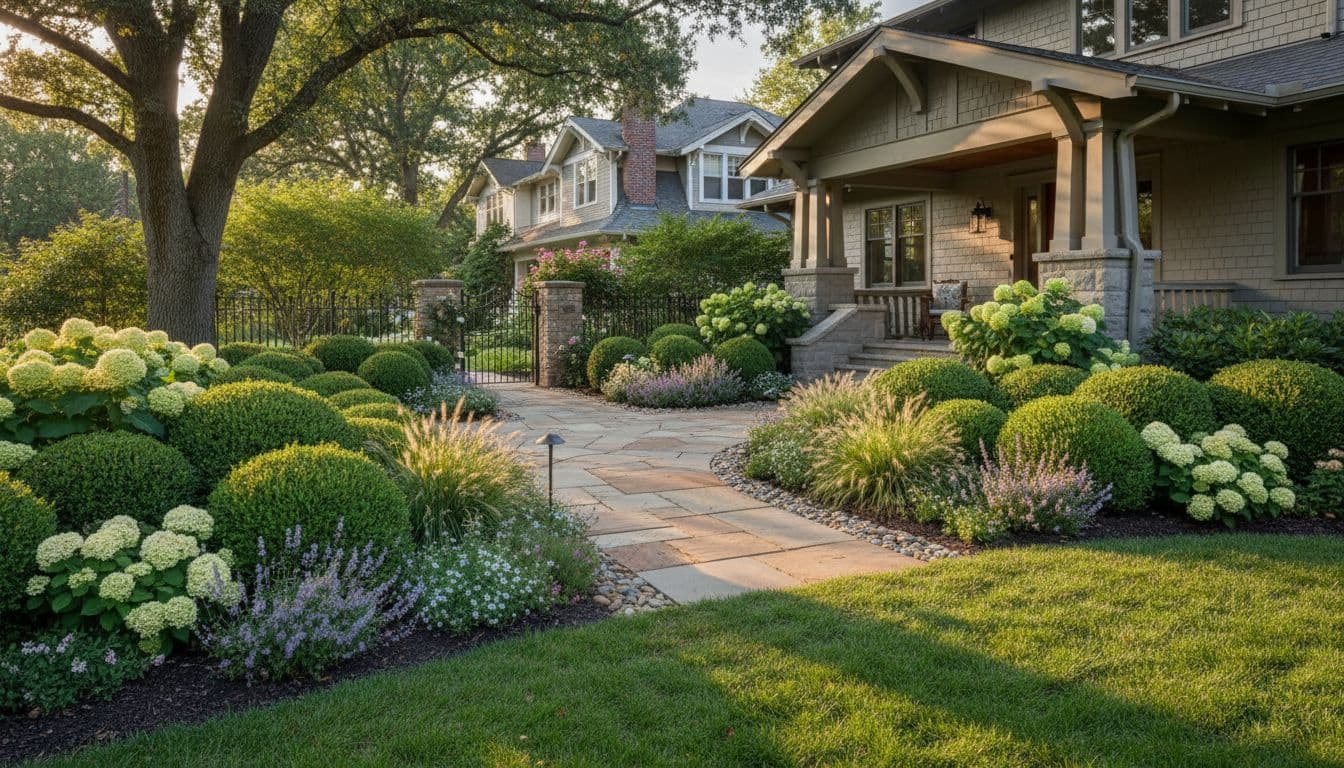
Because FlorAI plans from a photograph rather than a blank grid, those fixed points are already in the picture. The wall stays a wall. The level change stays a level change. What comes back is an arrangement that could actually exist on your plot, not a beautiful layout that assumes a flat rectangle you do not own.
- Boundaries, walls and fences stay where they are
- Existing trees and level changes are worked around
- Access routes and utility covers stay reachable
- The garden's real proportions are respected

What goes wrong
Three planning mistakes that are expensive to undo
Planting mistakes are cheap — a shrub in the wrong place is a Saturday and a spade. Layout mistakes are the ones that cost money, because they are usually made in stone.
The most common is a patio sized for the furniture catalogue rather than for pulling a chair out. The second is a path that goes where the drawing wanted it rather than where people walk, which is why so many gardens have a worn line across the lawn. The third is leaving screening until last, when the only fast fix is a hedge that will need cutting twice a year forever.
- Seating areas too small once chairs are pulled out
- Paths that ignore the route people already take
- Screening added last, as an emergency
- Storage forgotten entirely until the bins need somewhere to go
Comparing
The value is in seeing the options side by side
A single plan is hard to judge. You have nothing to weigh it against, so you either accept it or feel vaguely uneasy without being able to say why. Two or three arrangements of the same garden make the trade-offs visible immediately — this one gains a bigger lawn but loses the evening sun, that one gains privacy but feels tighter.
That comparison is the part a photo-based planner does cheaply. Producing a second full arrangement costs about ten seconds, so there is no reason to settle for the first idea simply because redoing it would be tedious.
FAQ
Questions people ask
What does an AI garden planner actually decide?
+
The arrangement: where seating, paths, beds, screening and focal points go, shown on a photo of your real garden rather than as a plan-view diagram.
Does it know where my drains and boundaries are?
+
It works from what is visible in your photograph, so walls, fences, level changes and visible features are respected. It cannot see underground services — check those against your own records before digging.
How many plans do I get for free?
+
Three per day, with no credit card. The allowance resets daily, so comparing several arrangements across a week costs nothing.
Can it help with a garden that is an awkward shape?
+
Yes — narrow plots, sloping ground, L-shapes and shaded corners are exactly where planning matters most, and the AI works around the shape rather than ignoring it.
Will it tell me what to plant?
+
It suggests planting suited to the style and your location, and it can identify plants from a photo. Check any species against your USDA zone before buying.
Is this a substitute for a garden designer?
+
For deciding an arrangement, it gets you a long way. For levels, drainage, retaining structures or anything requiring permission, a designer or contractor is still the right call.
Plan your garden around what is really there
Three free plans a day. Start from the constraints, not a blank page.